
Harvard College: Fit and Supplemental Essay Research Guide
Maybe you’ve heard of it. Harvard is a private, urban college of about 7,200 undergraduates, and it admits roughly 3 in 100 applicants. For admitted students, the college meets full financial need. This guide pulls together what The Princeton Review reports about Harvard, what Harvard says about itself, and a research plan for each of the five required supplemental essays.
What students say
Student comments in The Princeton Review describe a place that is intense, resource-rich, and driven by people who stay busy. These are survey impressions rather than measurements, so treat them as leads to test in your own research.
Academics. Students call the workload demanding but say the competition is more "latent" than cutthroat, because there are enough opportunities to go around. The recurring complaint is that Harvard offers more than anyone can use. Some large introductory courses are taught through teaching fellows in sections, so students say you have to go to office hours to get to know the lecture professor. Once you do, they describe faculty as very reachable. Students also credit the alumni network and internship pipeline, and they praise first-year advising even while calling the administration slow to change.
Campus life. Cambridge and Boston supply plays, concerts, restaurants, and parties, so students rarely feel short on options. The social scene is described as lively without a heavy party culture. Weekend parties happen at the finals clubs, and students say there is little pressure to join in. There are no fraternities or sororities.
Student body. Students use the same words again and again: ambitious, hardworking, involved in many activities, short on sleep. They also describe real variety in ethnicity, religion, ideology, and family background, and they report an atmosphere of tolerance. The book lists enrollment as roughly 34% White, 23% Asian, 12% Hispanic, 9% Black, and 8% two or more races, with 13% international students. The gender split is 48% men and 52% women.
The book's "Survey Says" summary: great financial aid, a popular campus newspaper, politically aware students, and students who love Cambridge.
Questions this raises for your research:
The book lists most classes as small, yet students describe large intro lectures. Which is true in the departments you care about? Check the course catalog and published enrollment figures.
If getting to know big-lecture professors takes effort, what does that look like for a student who is quiet or new to office hours?
If everyone is busy with extracurriculars, how do students find downtime, and does that match how you recharge?
How to get into Harvard
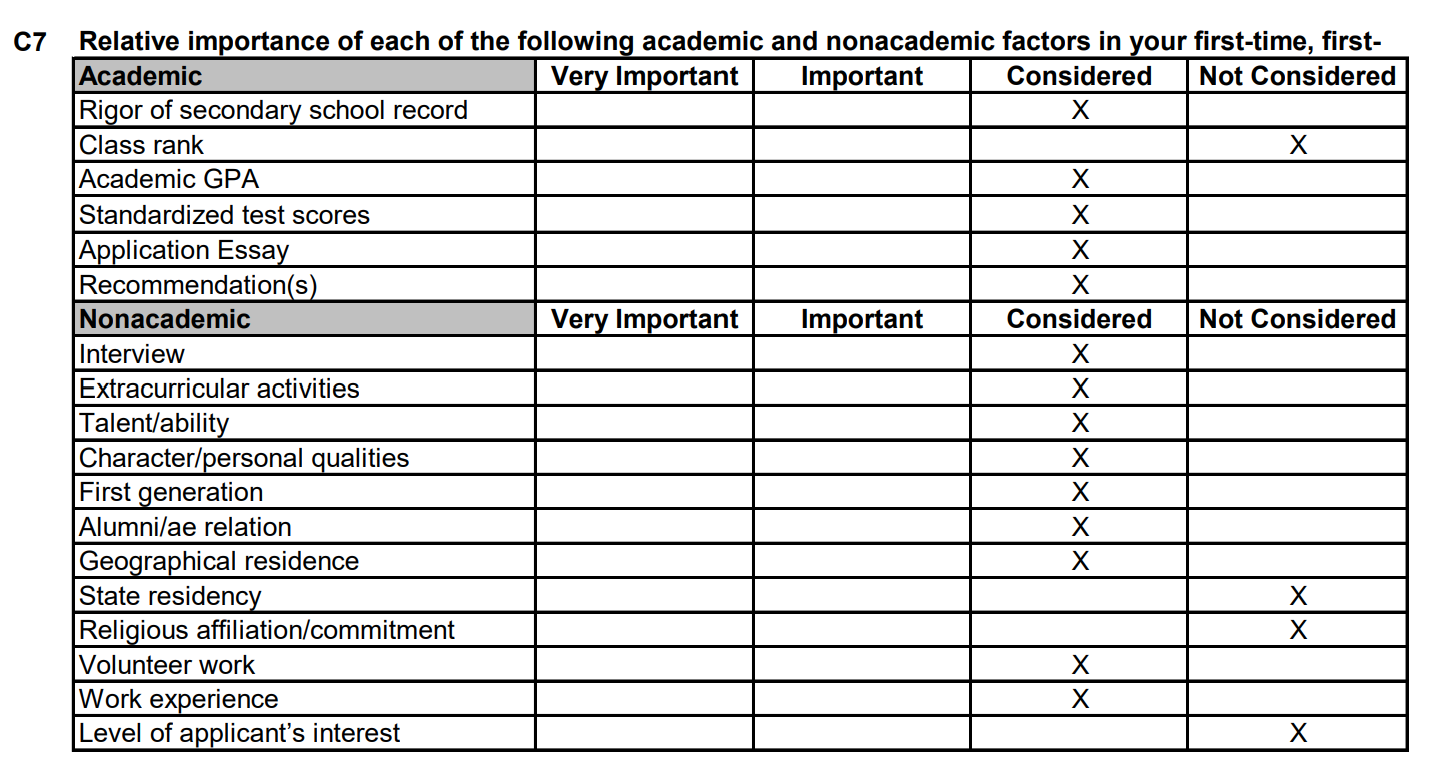
Check out Harvard’s 2025-2026 Common Data Set. Below, you’ll find Table C7: Relative importance of each of the following academic and nonacademic factors.
Harvard's own pages say several things that matter for how you approach the supplements:
Quality over quantity in activities. Harvard says it cares more about depth than about filling the activities grid, and it counts family responsibilities and work to support a family as real activities.
Grades and tests are hard to separate. Harvard says most applicants and admitted students have outstanding records, which makes high school grades hard to use to tell applications apart. It also says test scores predict Harvard grades better than high school grades do.
No program quotas. Harvard says it does not admit students into specific programs and has no quotas or targets by field. Intended concentrations are a signal of current interests, not a commitment.
Need-blind admissions. Applying for financial aid is never held against you, according to Harvard's application tips.
Math. Harvard recommends four years of high school math but says calculus is not required.
Section C7 of the CDS lists how Harvard rates each factor. Harvard marks every factor it uses as "Considered" and none as "Very Important" or "Important," so the CDS does not rank the factors against each other.
What this means for your essays
This section is my interpretation, not Harvard's. When about 95% of enrolled students have GPAs of 3.75 or higher and test scores cluster in the 700s, strong academics describe most of the pool. The five written answers are among the few places where an applicant shows who they are beyond the numbers. Four of the five questions ask about you as a person, so specific, honest answers carry weight. Because Harvard says it does not consider level of applicant's interest, an essay does not need to prove enthusiasm for Harvard. Prompt 4 asks about your future, so write about that rather than about how much you admire the school.
Is Harvard a fit for you?
Harvard suits students who build their own path, ask for help without being prompted, and get energy from ambitious peers. With a 3% admit rate it is a reach for every applicant, so it belongs in the Reach column of your list however strong your record is. Fit decides whether it earns a place on the list at all.
Students who tend to thrive, based on what the book reports
Self-starters who will email a professor or attend office hours to get what they want from a big course.
Students who like an urban setting and want a city on the doorstep. The book's survey says students love Cambridge.
Students who enjoy being around very busy, driven people and can handle that pace without feeling measured against it.
Students who want a residential experience. Nearly everyone lives on campus, and there is no Greek system.
Students who may want to look harder
Students who need a guaranteed small-class feel in every first-year course. The book's own student comments describe larger introductory lectures supported by teaching fellows.
Students who want a campus where a fraternity or sorority scene, or a traditional party scene, anchors social life. Students describe that as not prevalent.
Students who need merit scholarships. The book shows 0% of students with need receiving non-need-based aid, so Harvard's help is need-based.
Students who feel pulled down by an atmosphere of constant achievement and little sleep.
Anti-List check. In the GAL College List Organizer, you list conditions that would make a school wrong for you before you fall in love with it. Test Harvard against yours. A few examples worth asking:
Would I be unhappy if I had to seek out faculty rather than have them seek me out?
Do I need a net price I can only get with merit aid?
Do I need a social scene that Harvard's students say is not central there?
Would I choose Harvard if it had less name recognition? If the honest answer is no, that tells you something before you write a single essay.
Deep research: the 11 steps applied to Harvard
The Guided Ambition Lab Deep College Research Guide has eleven steps that go past the admissions homepage. Here is what each one looks like for Harvard, and which essay it can feed. Keep your notes in the Deep College Research tab of the College List Organizer. Most of this research will never appear in an essay, because 150 words only has room for the sharpest detail.
Looking for the Deep College Research Guide? Get the Guided Ambition Lab now.
Step 1: Mission statement. Read Harvard's mission page. Open a rival's mission statement beside it (Yale or Princeton work well). Find the one phrase Harvard uses that the other doesn't. Feeds Prompt 4.
Step 2: Distinguishing factor. Harvard calls majors "concentrations." Look at how concentrations, secondary fields, and the residential house system after first year work, then ask how your daily life would differ from a typical university. Feeds Prompts 3 and 4.
Step 3: Departmental map. On the concentrations page, click through to your department. Look for tracks, joint options, and secondary fields that fit your niche, not just the concentration name. Feeds Prompt 4.
Step 4: Syllabus snippet. Find one course in your intended concentration with a detailed description or syllabus. Note one reading, project, or assignment you would actually want to do. Feeds Prompt 4.
Step 5: Faculty test. Browse the department's faculty pages and the college's research page. Find one professor with a specific focus and read the abstract of a recent paper. Ask whether you would have a question for them. Feeds Prompt 4.
Step 6: Active tourist. Take the virtual tour or visit in person. Ignore the script and read the flyers: what events are posted, and would you go? Feeds Prompts 3 and 5.
Step 7: Reps and fairs. Use the Meet Us Online sessions. Ask a High-Value Question, such as how first-years in your area of interest get involved in research. Feeds Prompt 4.
Step 8: Students and alumni. Use the Connect With Students page. Ask about the negatives: "What kinds of students would not do well here?" and "What does a Tuesday night look like?" Feeds Prompts 1 and 5.
Step 9: Op-ed deep dive. Read three opinion pieces in the student newspaper, the Harvard Crimson. What are students complaining about, and where do you land? Feeds Prompt 2.
Step 10: Third place. Name one place outside the dorm and classroom where you could see yourself spending time. Browse the student activities page and club listings. Feeds Prompts 3 and 5.
Step 11: Strategic plan hack. Look for where the college is investing. Read the dean's messages to students and speeches for priorities, and note anything that connects to your goals. Feeds Prompt 4.
Two research questions specific to Harvard. First, ask how undergraduates in your department get connected to research, and how early. Second, ask how students find faculty when intro courses lean on teaching fellows, since that is the experience the Princeton Review's student comments describe.
The five supplemental essays
Harvard requires five short answers of 150 words each, on top of the Common App personal essay. Harvard's application tips say the set is meant to show how your experiences shaped you, how you will engage with others, and what you aspire to do. Prompt wording is paraphrased below, so copy the exact wording from Harvard's page into your final post or draft. These five match Harvard's application tips page, which Harvard updated on September 23, 2026.
Prompt 1: Life experiences and contribution
What it asks. Harvard says it values a student body with many perspectives and experiences. It asks how the experiences that made you who you are will let you contribute to Harvard.
Approach. Pick one source of perspective, one specific way it shows up in how you act, and one sentence on what that looks like in a Harvard setting. Naming an identity is not an answer by itself, and what you disclose is your choice.
Research that helps. Use Step 8 to ask students what perspective the people around them bring, and Step 10 to find a real space or group where your perspective would matter.
Brainstorm. What do people come to you for? What do you notice that others miss because of where you have been or what you have done?
Watch out. Spending 140 words on the experience and ten on the contribution.
Prompt 2: A strong disagreement
What it asks. Describe a time you strongly disagreed with someone about an idea or issue. How did you communicate or engage with them, and what did you learn?
Approach. Choose a real disagreement with a real person where the stakes were yours. Answer all three parts: the disagreement, what you actually did in the conversation, and what you learned. One concrete move you made will do more than a claim that you listen well.
Research that helps. The Step 9 op-ed reading shows what campus debate sounds like. Use it to check your comfort with open disagreement, not to borrow a topic.
Watch out. Choosing a national political issue and writing a position paper. At 150 words, the argument will crowd out the engagement, which is the part Harvard asked about.
Prompt 3: An activity, job, travel, or family responsibility
What it asks. Briefly describe one extracurricular activity, job, trip, or family responsibility that shaped who you are.
Approach. Harvard's tips say it cares more about the quality of activities than their number, and that helping at home or working to support your family counts as a real extracurricular. Choose one commitment and separate what you did from what the group did. End on how it shaped you.
Research that helps. This answer comes from your own life. If it connects to something you want to continue, a quick look at Step 6 and Step 10 can confirm that Harvard has a place for it.
Watch out. A trip summary is the weakest version of this answer. If you write about travel, write about what you did there, not where you went.
Prompt 4: Using a Harvard education
What it asks. How do you hope to use your Harvard education in the future?
Approach. This is an aspirations question, not a full "Why Harvard" essay. Name a direction and root it in something you have already done. Harvard says plans may change and there is no right answer, so uncertainty is allowed. Use one or two precise details from your research to show you know what you would be using, rather than a list of programs.
Research that helps. Steps 3, 4, and 5 give you a specific concentration track, a course reading, and a professor. Step 7 gives you a first-year research example from the admissions team. Step 11 shows where Harvard is investing.
Watch out. A catalog of courses and clubs that leaves no room for "you."
Prompt 5: Top three things your roommates might like to know
What it asks. List the top three things your roommates might like to know about you.
Approach. Choose three items that are specific, true, and different in kind from each other, such as a habit, a value, and a quirk. Each can have one sentence of explanation.
Research that helps. Step 6 and Step 8 tell you what living with peers looks like day to day. Since first-years live on campus, ask students what makes a good roommate.
Brainstorm. Ask someone who has shared a room, a car, or a long trip with you what living with you is like.
Watch out. Three achievements in disguise.
Sources
Checked October 1, 2026. Statistics and policies change, so confirm any figure on Harvard's own site before citing it.
Princeton Review, The Best 389 Colleges, Harvard College profile (p. 289 and the preceding page): enrollment, ratings, student comments, admissions and financial aid figures. Figures are from the edition photographed and may be out of date.
Harvard College: Application Requirements: current testing policy, deadlines, and the five supplement questions.
Harvard College: Application Tips: guidance on activities, plans, and the writing supplement.
GradPilot: Harvard Supplemental Essays 2026-27: used only to cross-check the prompt list against Harvard's pages.
Guided Ambition Lab, College Research Scavenger Hunt and College List Organizer (Deep College Research tab): the 11-step research framework and the Anti-List and Financial Stress Test tools.
Harvard Common Data Set 2025-26: applicants, admits, enrollment, test scores, GPA, class rank, deadlines, and policies for the fall 2025 entering class. The admit rate and yield are my calculations from its counts. The admissions section uses this source, not the Princeton Review.
