
Your College Application is a First Date
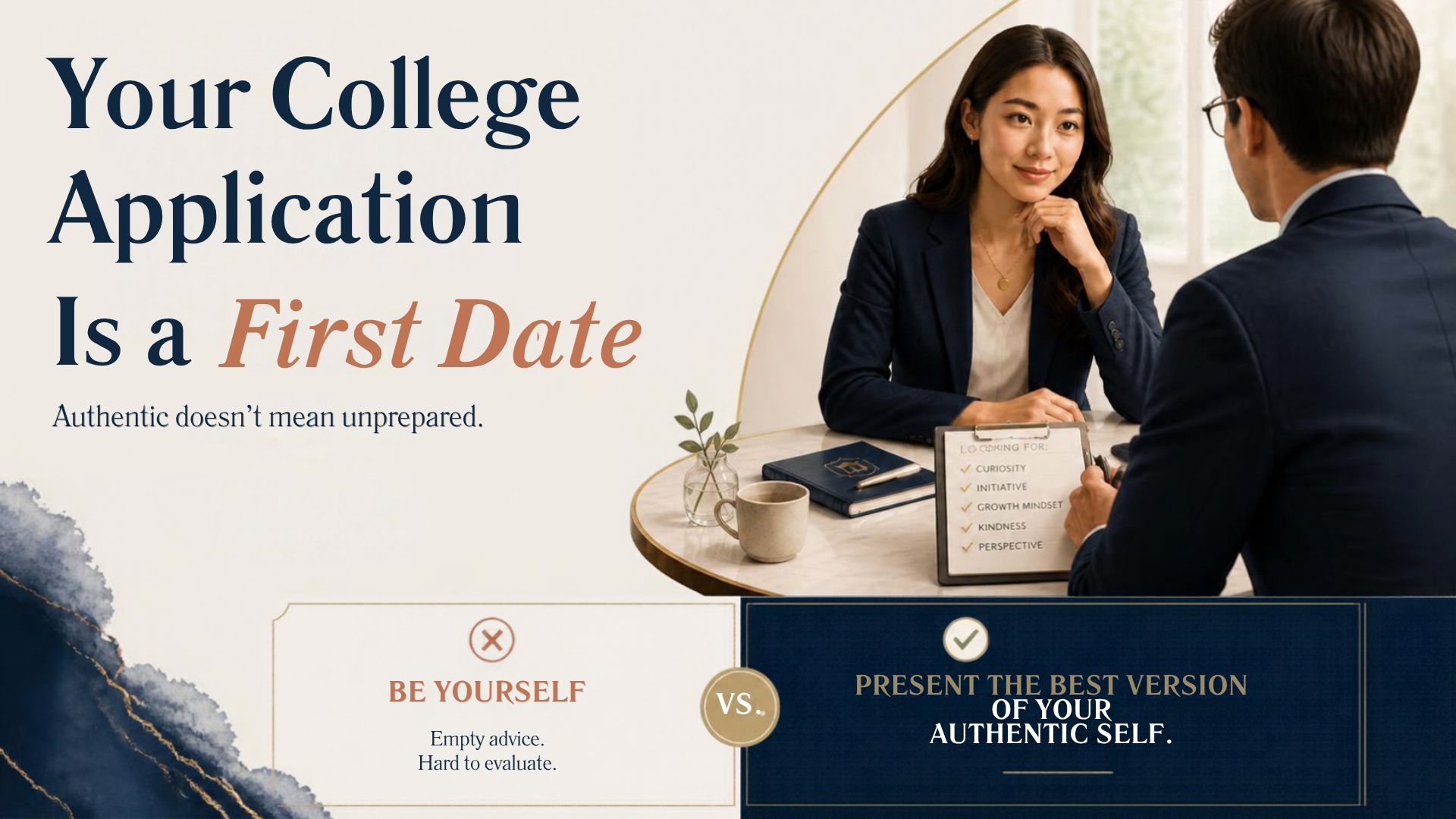
The most over-stated and least explained advice in college admissions strategy is some variety of this.
Be authentic.
Be yourself.
Admissions officers are the guiltiest offenders. The last thing that admissions officers want to do is discourage you from applying. That’s why their advice is so milquetoast all the time. That’s why they lob empty platitudes like “be authentic” and “be yourself.” If they told you what they actually wanted, it would discourage thousands of people from applying who categorically can’t provide what they’re looking for. They want to embolden you to apply because more applications drive down their acceptance rate and boost their apparent prestige.
Remember: Admissions is marketing.
But that advice means nothing to someone unfamiliar with the world of college admissions strategy.
If the pilot of your United flight suddenly fell into a coma and you were tasked with piloting the plane, would it help if someone asked you to “be yourself?” No, because it’s impossible to be yourself in a context you don’t understand. In these contexts, you seek out advice and imitate the behaviors of people who seem more qualified and comfortable than you.
Likewise, when students enter the world of college admissions strategy, they hear “be yourself” and tune that out. They look not at the people who are objectively the most qualified to give them advice, but at the people giving the clearest, most unequivocal, most confident advice. That's also the advice social media algorithms most reward.
Counselors need to challenge this genre of over-confident, fearmongering advice with advice that balances the nuance of proper holistic admissions strategy with the eye-catching, scroll-stopping language that competes for time and impressions on social media.
This is my contribution: Your college application is a first date.
What’s the goal of a first date? To get a second date. Even if you ultimately decide that a college or romantic prospect is not for you, you want to be the one with the power to make that decision, not them.
That means knowing yourself well enough to quickly present the best version of your authentic self. Authenticity is still important! At a dinner date or in your personal statement, you can’t sound scripted. You don’t list your resume and achievements. It helps to be a little funny. You need to look comfortable in your own shoes. You need goals that exist independently of your romance/college. Personal, vulnerable subjects can come up on a first date, just as they can in a college application. However, you should show some distance from those challenges. You shouldn’t present as if you’re still stewing deeply in that pain. You want to give the impression that you have grown from this experience and that you’re ready to engage positively with a prospective partner or college. You may leave out details on the first date or in your personal statement.
It’s disingenuous to tell an Ivy League applicant pool that all they need to do is “be yourself,” and then reject 96% of those applicants. There’s obviously something more to this process. Selective admissions officers are looking for the best possible presentation of the best applicants.
Admissions officers are much harder to get than they like to put on.
Harley Poston is an independent college admissions consultant and the founder of Stress Less College Apps, based in Oakland. He created the Guided Ambition Lab, a comprehensive college planning system and community that gives families a shared language, a weekly rhythm, and a clear path from 9th grade to decision day. Join the waitlist here.
